

GCEA BOOKS
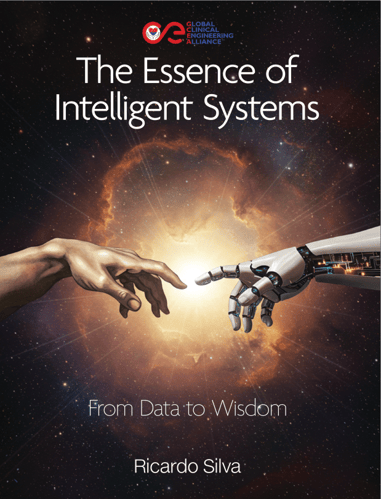
The Essence of Intelligent Systems — First edition.
Ricardo J. Silva, PhD, MBA, CCE.
An exploration of the foundations, design, and ethical implications of artificial intelligence and intelligent systems. The book bridges the fields of engineering, philosophy, and ethics to guide readers through the emerging challenges and opportunities of human–machine interaction and governance.
Identifiers:
ISBN 979-8-89604-287-7 (paperback)
ISBN 979-8-89604-288-4 (hardcover)
-
Artificial intelligence—Ethical aspects.
- Intelligent systems—Design and applications.
- Technology—Moral and ethical aspects.
- Information theory—Philosophy.
Classification:
LCC Q334 .S55 2025 (print)
DDC 006.3—dc23
Published by the Global Clinical Engineering Alliance in collaboration with WritersCosmos.
Summary and Key Insights
- Philosophical Foundations: It establishes a foundational understanding of philosophy, including Metaphysics (with a focus on Ontology for defining intelligent agents and their attributes), Logic (providing the structural framework for AI reasoning, knowledge representation, and programming, including formal, fuzzy, and modal logic), Epistemology (exploring how AI systems acquire, represent, and validate knowledge, emphasizing trustworthiness, explainable AI, and informed consent), and Ethics (addressing moral principles, accountability, transparency, bias, and data governance in AI development and deployment).
- Systematical Basis of Intelligence: This section introduces fundamental theoretical frameworks: Information Theory (quantifying information, entropy, and channel capacity), Systems Theory (viewing entities as interconnected components), and Communication Theory. It details the Data, Information, Knowledge, and Wisdom (DIKW) hierarchy, where wisdom is defined as the application of knowledge with ethical considerations and a deep understanding of context. It also offers a system-based definition of Life and describes Intelligence as the capacity to use information for purposeful action, leading to Sentience as the ability for subjective experience and value-driven decisions.
- Natural Intelligence: The book examines natural intelligence through a systems approach to the brain, discussing concepts like Teilhard de Chardin's Complexity/Consciousness axis and Albus's four functional elements of an intelligent system: Behavior Generation (BG), Sensory Perception (SP), Judgment of Value (JV), and World Modeling (WM). It also delves into the systemic origins of cognitive disabilities such as dementia, autism, and schizophrenia, linking them to impairments in neural networks.
- The Basis of Artificial Intelligence: It covers various AI techniques, including machine learning, deep learning, natural language processing, computer vision, robotics, and expert systems. Specific components discussed are Boolean classifiers, decision trees, rule-based reasoning, fuzzy logic (for handling uncertainty), and ontologies (for structuring domain knowledge).
- Knowledge Representation and Reasoning: This section explores how knowledge is encoded for computers, detailing approaches like data representation, semantic networks, frames, case-based reasoning, probabilistic reasoning, and the critical role of ontologies (e.g., SNOMED CT for healthcare interoperability).
- Genetics and Genomics: DNA is presented as a quadruplex digital code for biological information, with applications in sequence analysis, genome annotation, and protein structure prediction.
- Neuroidal Networks: The concept of a neuroid as a basic processing unit with operations like comparison and pulse/frequency modulation is introduced, forming the basis for artificial neuroidal networks.
- Domain Specific AI: Emphasizes task-optimized and contextually grounded AI, particularly in healthcare, addressing applications like disease detection, clinical decision support, and medical imaging, while highlighting challenges in data privacy, cybersecurity, and interoperability.
- Natural Language Processing (NLP), Transformers, and Large Language Models (LLMs): This covers the understanding, interpretation, and generation of human language, differentiating between Language Recognition (NLU) and Language Generation (NLG). LLMs are identified as deep neural networks crucial to NLP advancements.
- Artificial General Intelligence (AGI): The book considers AGI's aspiration to emulate human cognition and raises the provocative question of whether intelligence can exist without consciousness. It stresses the need for an "Ethical Engine" to guide AGI decision-making toward human-beneficial outcomes.
- Explainable AI (XAI): Positioned as a foundational pillar for AI integration into human decision-making, ethics, and trust. XAI addresses the "black box" problem of AI by making its reasoning interpretable and justifiable, which is crucial for trust, informed consent, accountability, bias detection, and safety in healthcare. Practical applications include explaining diagnoses and treatment recommendations.
- Biases in Artificial Intelligence: Highlights concerns regarding algorithmic bias in training data and its impact on performance metrics like sensitivity and specificity, potentially leading to misdiagnosis.
- Personalized Medicine and Digital Twins: Introduces concepts like Individualized Normative Deviation (IND) for early health change detection and atomized data as a foundation for personalized insights.
- Embodied Intelligence and Robotics: Discusses the spectrum of robots from assistive devices to anthropomorphic androids, noting that contemporary robots are characterized by autonomy, interactivity, communication, and mobility. It covers their use in healthcare (e.g., exoskeletons, carebots) and stresses ethical and ergonomic design.
- Towards an Ethical Architecture for AI: Explores emerging paradigms in machine ethics, including Fairness, Accountability, Transparency, and Ethics (FATE). It addresses ontological ethics and artificial personhood, debating AI agency and rights, and proposes a computational implementation of ethics using concepts like Patient Ethical Value (PEV) for medical interventions.
- AI Accreditation: Examines diverse stakeholder perspectives on explainable AI for accreditation and discusses the Turing Test's limitations, advocating for a new paradigm that emphasizes wisdom in evaluating intelligence, understanding human values, and promoting symbiosis between humans and AI.
The book ultimately calls for integrating wisdom and ethical foresight into AI systems to ensure technology serves humanity's best interests and enhances well-being.

Join the GCEA's
Choosing the membership type that best suits you.